Madam C. J. Walker
Hair care pioneer and self-made millionaire. Born to formerly enslaved parents, Madam C. J. Walker built a hair care empire and a sales force of thousands of women in the early 1900s.
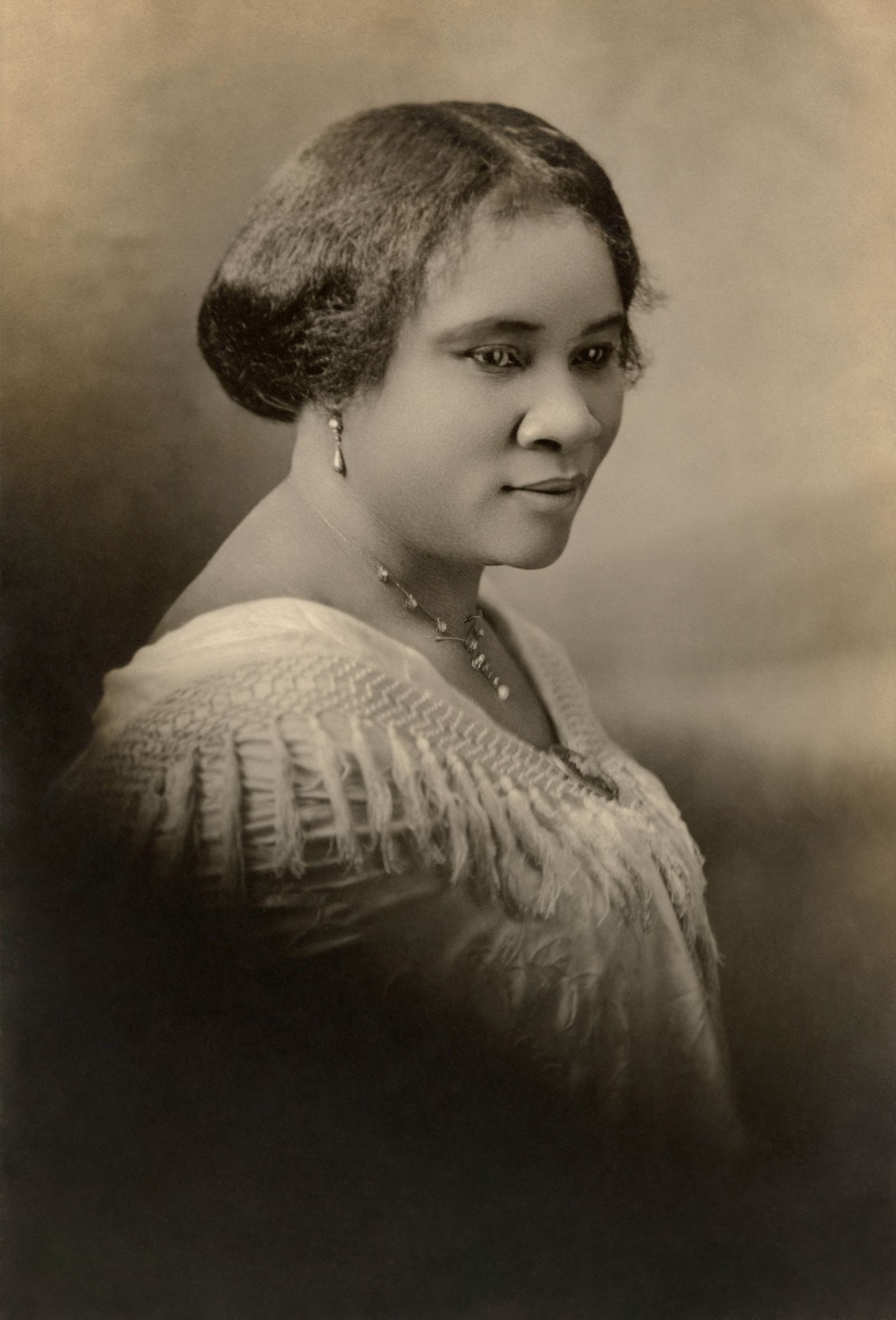
Madam C. J. Walker: Addison Norton Scurlock / Adam Cuerden, Public domain
From the cotton fields
Sarah Breedlove was born in 1867 on a Louisiana plantation, the first child in her family born free after the Civil War. Orphaned at age seven and widowed while still a young mother, she moved to St. Louis and worked as a washerwoman for very low wages while raising her daughter, A'Lelia.
Like many women of the time, she suffered from scalp problems and hair loss. She began working as a sales agent for a hair care entrepreneur, Annie Malone, and experimented with her own formulas.
Building the brand
In 1906, in Denver, she married Charles Joseph Walker and began selling her own product, Madam Walker's Wonderful Hair Grower, under the name Madam C. J. Walker. She traveled across the South and beyond, demonstrating her method in homes, churches and meeting halls.
She moved operations to Pittsburgh, where she opened a training school, and then in 1910 to Indianapolis, where she built a factory and headquarters. Her company later put up the landmark Walker building on Indiana Avenue, completed in 1927 after her death.
An army of agents
Walker's real innovation was her sales force. She trained thousands of women, mostly Black women, as Walker agents who sold products and offered treatments in their communities. For many it meant far better pay and more independence than domestic work. In 1917 she brought agents together at a national convention in Philadelphia, rewarding top sellers and encouraging them to support charity and civic causes.
By the time she died in 1919 she was widely regarded as one of the first self-made women millionaires in America, and she left much of her fortune to schools, charities and civil rights work.
She also used advertising in Black newspapers and placed her own image on product packaging, a bold choice that told customers the founder looked like them and stood behind what they were buying. Few businesses of the era marketed so directly to Black women.
The boss lesson
Walker understood that a great product needs a great distribution system. Instead of waiting for stores to stock her line, she built a network of people who believed in it and earned real income from it. That direct-sales model let her grow without big retail partners.
She also paired business with community investment. Lifting up her agents strengthened her brand, proof that profit and purpose can reinforce each other.

- National Women's History Museum: Madam C.J. Walker
- Wikipedia: Madam C. J. Walker
- Madam C.J. Walker: Official site
Facts on this page were checked against these sources.
- Madam C. J. Walker: Addison Norton Scurlock / Adam Cuerden, Public domain
- Madam C. J. Walker building, Indianapolis: Nyttend, Public domain
Text written by Biggest Bossman.